
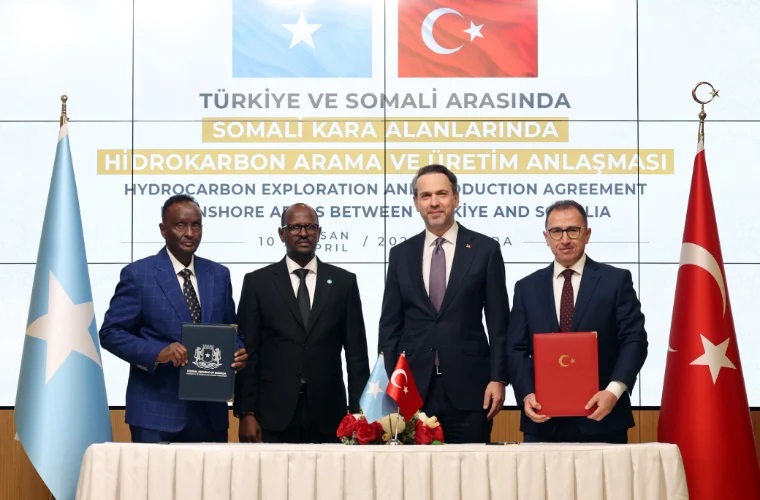
Turkey plans to begin oil drilling off the coast of Somalia in 2026 following the completion of extensive seismic surveys, marking the latest step in Ankara’s deepening strategic engagement in the Horn of Africa, the Middle East Eye reported, citing Energy and Natural Resources Minister Alparslan Bayraktar.
Bayraktar, who spoke to journalists on Wednesday, said Turkish teams had wrapped up their seismic operations in three offshore blocks allocated to the Turkish Petroleum Corporation (TPAO), each covering roughly 5,000 square kilometers.
The Oruç Reis research vessel had conducted three-dimensional surveys in the region after being deployed to Somali waters in October 2024 with naval escorts due to security risks.
“We completed our seismic operations this year, and most likely 2026 will be the drilling year for us in Somalia’s offshore zone,” Bayraktar said, adding that an official announcement could come in January once all the data is finalized.
A Turkish official familiar with the process had told Middle East Eye last month that seismic results would be fully ready early in the new year.
Bayraktar said newly acquired ships would be sent to conduct deep-water drilling, describing the planned operations as “highly complex” and noting that they would take place at depths of around 3,000 meters.
Land drilling to also begin next year
The minister also confirmed that operations would not be limited to the offshore blocks. “In 2026 we aim to begin not seismic work, but direct drilling in the onshore blocks as well,” Bayraktar said.
A Somali source told reporters that a tender for constructing road access to inland drilling sites would soon be launched to ensure that infrastructure is ready in time.
Despite Ankara’s confidence, Bayraktar admitted serious logistical and security challenges.
“There is not even a road to reach the region. We need to build all the required infrastructure. Security is another issue, and we are working to address all of these,” he said.
The Turkey–Somalia partnership has expanded significantly over the past decade. Turkey now operates its largest overseas military base, Camp TURKSOM, in Mogadishu and has trained thousands of Somali troops since 2017.
Turkish companies manage the capital’s airport and port, and Ankara has provided more than $1 billion in humanitarian assistance since a devastating drought in 2011, when President Recep Tayyip Erdoğan made a landmark visit to the country.
In February the two countries signed a new framework agreement deepening cooperation on maritime security, anti-piracy operations and natural resource protection. The deal established a joint naval force to patrol Somali waters for 10 years, enabling Turkey’s energy fleet to conduct seismic and drilling operations under military protection.
The Somali government hopes the partnership will unlock vast untapped resources.
According to US government assessments, Somalia may hold at least 30 billion barrels of oil and natural gas. But experts warn that exploiting these reserves could require three to five years of sustained investment once commercially viable discoveries are confirmed.
An energy specialist quoted by Middle East Eye last year estimated that Turkey might need to spend up to $500 million on exploration and initial drilling activities, with several billion dollars more needed to bring any discoveries to production.
Tturkish Mminute