
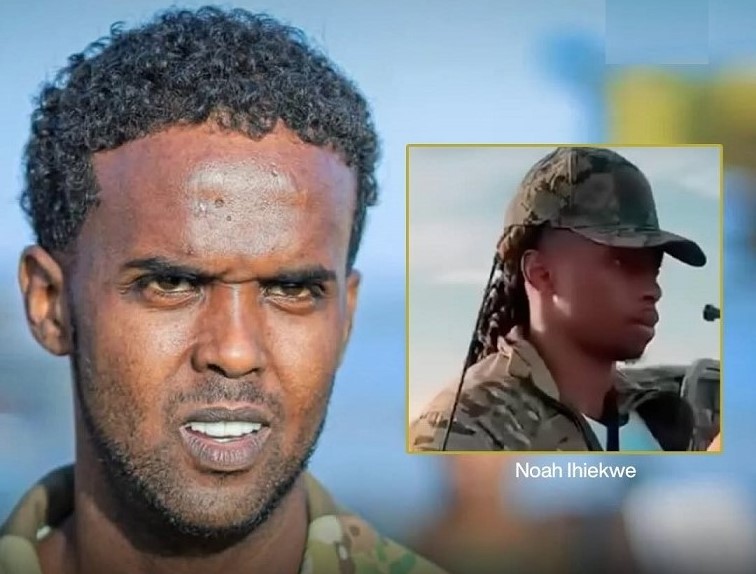
Two drill rappers from Liverpool who were seen carrying guns and parading with troops in Somalia during a cross-border clan conflict could be questioned by police upon their return to the UK, the BBC has learned.
British citizens Abdifatah Gulaid, 31, and Noah Ihiekwe, 30, travelled to the north-east of the African country earlier this year.
The pair, both from the Toxteth area of Liverpool, produce music under the names Still Brickin’ and Rayzer.
In footage obtained by the BBC, Mr Gulaid can be heard telling armed troops: “The time for talk is finished.”
The extent of the men’s involvement with the troops is not known, but the government told the BBC that “any person who travels from the UK to conflict zones to engage in unlawful activity should expect to be investigated upon their return”.
Mr Gulaid is affiliated to the Warsangeli clan which has been embroiled in tension and fighting with the rival Isaaq clan.
Mr Gulaid and Mr Ihiekwe, who were both seen in a hotel in Badhan in the Sanaag region in the north of Somalia, did not respond when contacted by the BBC.
In the week prior to their arrival in Somalia, the BBC understands they, along with four other men, were detained in Phuket, Thailand, during a drugs raid.
Thai police stormed a luxury villa in the Ratsada district at about 06:30 local time on 23 January and recovered 12 bags of cannabis, weighing about 6kg, and 39 tanks of nitrous oxide, also known as laughing gas.
Cannabis was legal in Thailand at the time for personal use, but its sale without a licence was prohibited.
The men were later released without charge.
The BBC has approached the Thai authorities for further information.
Analysis of the rappers’ own social media and eyewitness accounts suggest in the days following the drugs bust they travelled to Sanaag, in north-east Somalia.
The region is claimed by both the self-declared republic of Somaliland and by Somalia’s autonomous state of Puntland.
Somaliland declared independence after the overthrow of the Somali military dictator Siad Barre in 1991.
Though not internationally recognised, Somaliland has a working political system, government institutions, a police force and its own currency.
Puntland declared itself an autonomous state in August 1998, but unlike Somaliland, it does not seek recognition as an independent entity.
There has long been tension between clans in the region due to competition over resources and vendettas going back generations.