
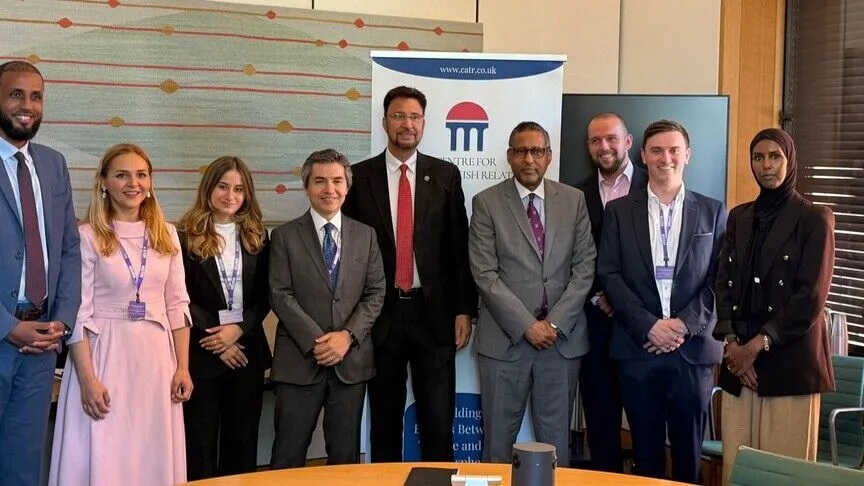
Türkiye’s long-term engagement in Somalia, built on development, security cooperation and sustained political commitment, has created a foundation for stability that could be strengthened through closer cooperation with the UK, speakers said during a discussion at the UK Parliament.
The event, titled “Anchoring Stability: Aligning the UK, Türkiye and Somalia in the Horn of Africa,” was hosted Monday by the Centre for Anglo-Turkish Relations (CATR) at the House of Commons in partnership with the Horn Report and Geopol Report.
Addressing the meeting, Turkish Ambassador to the UK Osman Koray Ertas said Türkiye’s engagement with Somalia has never been limited to humanitarian aid but has developed into a comprehensive partnership supported across Turkish society.
Türkiye’s relationship with Africa, not only with Somalia but with Africa as a whole, has been a fundamental part of its foreign policy, he said. The policy is not only about aid but is also strongly supported by different segments of Turkish society, including the private sector, civil society, Maarif schools and development actors, Ertas said.
He stressed that Türkiye’s ties with Somalia are rooted in history and shared solidarity.
“There is a strong affinity between our country and our nation and Somalia and Somali people. This relationship has its roots in history. We feel ourselves close to our sisters and brothers in Somalia, and we try to be with the Somalian people in their difficult times,” he said. 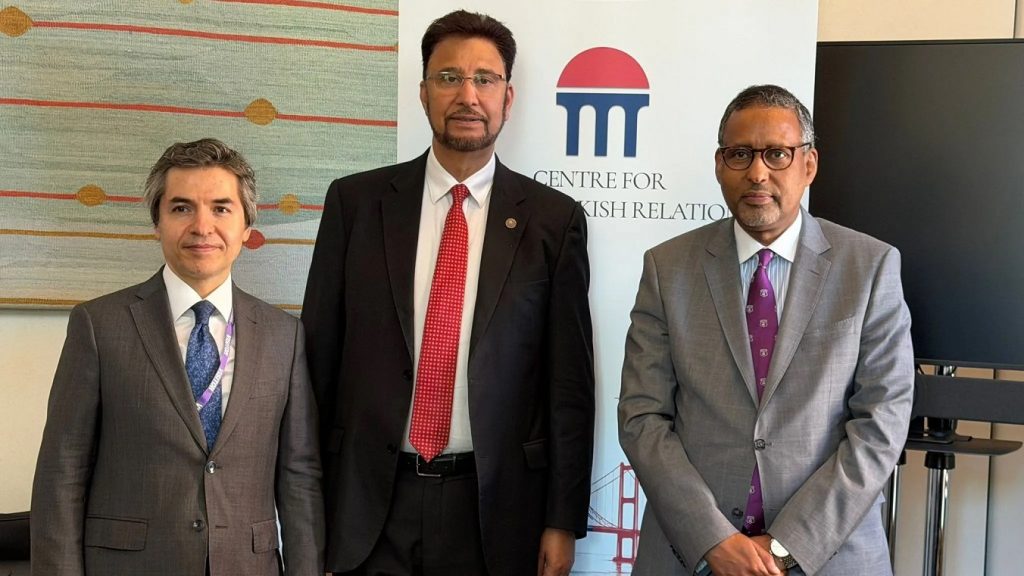
Development-driven partnership with Somalia
Noting that Somalia has made significant progress despite ongoing challenges, Ertas said Türkiye has remained committed throughout the country’s recovery process.
“Things were very difficult in the past. Comparatively, it’s in much better shape now. And during these difficult times, we continue to be part of this positive process,” he said.
Welcoming international support for Somalia, including from the UK, Ertas said Ankara sees cooperation rather than competition as the way forward.
“We welcome support of international governance in Somalia, including the UK,” he said, adding that Türkiye’s Somalia policy enjoys broad domestic backing, with numerous Turkish NGOs actively participating in reconstruction and development efforts.
Highlighting Türkiye’s development footprint, Ertas said the Turkish Cooperation and Coordination Agency (TIKA) has implemented more than $1 billion worth of sustainable projects in Somalia since 2011.
He also pointed to Türkiye’s investments in healthcare, including a major hospital in Mogadishu staffed by Turkish medical volunteers, as well as joint projects in fisheries and hydrocarbons.
He also underlined Türkiye’s security cooperation with Somalia, including the training of over 20,000 Somali security personnel.
Speaking at the event, Somali Ambassador to the United Kingdom Abdulkadir Hashi welcomed the report presented by the Centre for Anglo-Turkish Relations, saying it reflects Somalia’s transformation from a country dependent on humanitarian assistance to one focused on development and investment.
“With respect to the report, first of all, I truly appreciate framing Somalia as a country that has moved away from humanitarian dependency and toward a development objective—one that is ready for foreign investment and partnership-based global action. That framing was very, very welcome,” Hashi said.
He said the report’s proposal for closer trilateral cooperation between Somalia, Türkiye and the UK builds on already strong bilateral relationships.
“The core objective of the report is the trilateralization of our already meaningful bilateral relations with Türkiye by adding the United Kingdom to that equation. As the Somali Ambassador to the UK, nothing could make me happier than to see our best friend, Türkiye, and my host country, the UK—which has also truly stood by us—form a closer cooperation,” he added.
‘Somalia and Türkiye are both extremely important partners’
Chairing the event, Afzal Khan, Labour Party MP and former UK Trade Envoy to Türkiye, said closer cooperation among allies has become increasingly important amid growing global instability.
“Somalia and Türkiye are both extremely important partners. As we see global insecurity with the ongoing war in Ukraine and the unrest across the Middle East, strengthening ties with our allies in the meeting has become even more pertinent,” Khan said.
He said the CATR report correctly identifies the foundations for achieving lasting stability in Somalia.
“This report by the CATR rightly identifies the long-term stability in Somalia, which benefits not just Somalia but the whole of Africa, and indeed the UK is best advanced through three key pillars: strengthening solitude axis, accelerating investment and economic growth, and deepening trilateral cooperation between Somalia, the UK and Africa,” he said.
Khan also argued that development should increasingly replace aid dependency.
“For too long, the West has given aid to Somalia and expected it to grow and recover, but it cannot do this dependent on aid alone, and I’ve always looked at this issue with the idea that we’ve got to deal with the symptoms and the causes,” he said.
Presenting the Centre for Anglo-Turkish Relations’ report, CATR Director Ceren Kenar said Türkiye’s engagement with Somalia has evolved from humanitarian assistance into a strategic partnership over the past decade.
“Türkiye’s relationship with Somalia began with Turkish President Recep Tayyip Erdogan’s historic visit during the 2011 famine, when he became the first non-African leader to visit Mogadishu in nearly two decades,” she said.
“What started as humanitarian assistance gradually evolved into a strategic partnership,” she noted, adding that Somalia should increasingly be viewed as a country of opportunity rather than crisis.
“Somalia is not simply a country facing challenges. It’s a country of enormous potential and opportunities. It has the longest coastline on mainland Africa, a young and entrepreneurial population, significant agricultural resources and its strategic location along some of the world’s busiest maritime routes,” she said.
“These strengths position Somalia to become an important economic and regional partner,” she highlighted.
She also said Türkiye’s engagement now extends across education, infrastructure, trade, investment and security cooperation, with the report identifying four factors behind its effectiveness: long-term commitment, a sustained presence on the ground, mutual trust and a forward-looking vision.
Anadolu.